

open banking payments for high-risk merchants
Quick Answer
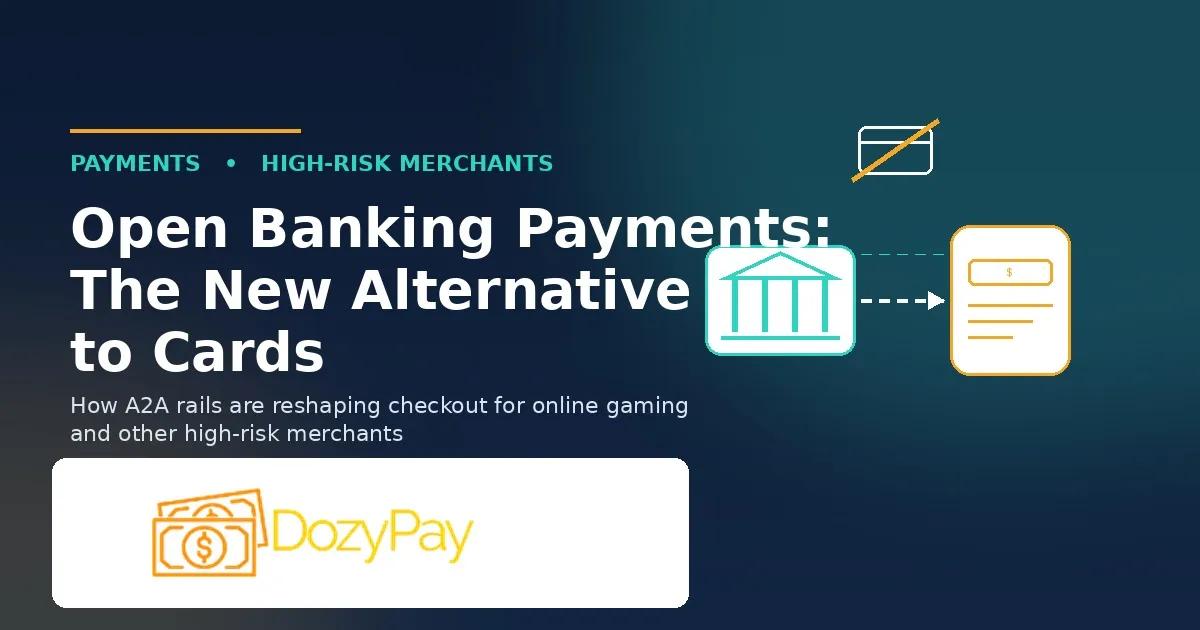
Account-to-account (A2A) payments — often called open banking payments — let a customer pay a merchant directly from their bank account, without a card network in between. For high-risk merchants, including online gaming and social gaming platforms, that matters because A2A transfers are typically final and irreversible, which removes most of the chargeback exposure that makes cards expensive and unstable for these businesses. A2A isn't replacing cards outright in 2026, but it's becoming a standard second rail alongside them.
Why Cards Have Always Been a Strained Fit for High-Risk Merchants?
Card payments were built around a network of issuing banks, card schemes, and acquirers, each of which prices in risk. For a mainstream retailer, that pricing is background noise. For a business operating a merchant account for online gaming, a subscription platform, or any other category card networks flag as high-risk, it becomes the central cost of doing business: higher interchange, rolling reserves, and constant exposure to chargebacks and "friendly fraud," where a legitimate purchase is disputed after the fact.
Decline rates compound the problem. Card issuers routinely block transactions from certain merchant category codes outright, regardless of whether the underlying business is fully licensed and compliant. An online gaming payment gateway built entirely on cards is, in effect, built on the least reliable rail available to it.
What Open Banking / A2A Payments Actually Change?
Open banking regulation — starting with PSD2 in Europe and followed by comparable frameworks elsewhere — gave third-party providers secure, consent-based access to a customer's bank account for the specific purpose of initiating a payment. The customer authenticates with their own bank, approves the amount, and the funds move directly from their account to the merchant's. No card number, no card network, no intermediary authorization chain.
Three properties of that model matter directly to high-risk merchants:
● Finality: bank transfers don't carry the same chargeback mechanism as card payments, which removes a major source of disputed-transaction risk.
● Higher approval ceilings: A2A rails can support larger transaction limits than many card issuers will approve for high-risk MCCs.
● Lower blended cost: without interchange and scheme fees, A2A transactions are typically cheaper per transaction, especially at volume.
This is why account-to-account payments are increasingly discussed as core payment processing for social gaming apps and other high-risk verticals, not just a niche alternative payment method tucked at the bottom of a checkout page.
Where A2A Adoption Actually Stands in 2026?
The clearest examples are regional. Brazil's Pix and India's UPI have made real-time bank transfers a default payment habit for hundreds of millions of consumers, not an edge case. In Europe, open banking checkout providers built on PSD2 access have moved from pilot programs to standard options at major merchants. In the UK, Faster Payments plays a similar role.
The US lags on a single unified real-time rail, but is catching up through FedNow and RTP network expansion, plus open-banking-style providers that connect directly to consumer bank accounts. For an online gaming payment gateway serving a global player base, that unevenness matters: A2A is often the strongest option in some regions and still immature in others, which is why most high-risk operators are adding it as a second rail rather than replacing cards wholesale.
What This Means for Online Gaming and Social Gaming Operators?
For casino, sports betting, and social gaming platforms, deposit and withdrawal speed is directly tied to player retention, and card declines are a recurring source of abandoned deposits. Adding an A2A option to checkout tends to do two things: it recovers players who were being blocked by issuer-level restrictions on gambling MCCs, and it reduces the chargeback volume feeding into the merchant's risk profile with their acquirer.
This is closely related to how gaming operators have already been diversifying away from card-only processing through ACH and eCheck payments for gaming merchants, which run over the same underlying bank-transfer logic as open banking, just via a different rail. Operators evaluating a high-risk merchant account for online gaming in 2026 are increasingly asking providers whether A2A and open banking checkout are supported alongside cards, not as an afterthought.
The Trade-Offs Worth Knowing
A2A payments solve real problems, but they aren't a drop-in replacement for cards, and a fair explainer should say so plainly:
● Refunds are manual. Without a chargeback mechanism, merchants need their own clear refund process — there's no automatic dispute pathway if something goes wrong.
● Coverage is regional. A rail that works well in Brazil, India, or the UK may not exist in the same form in other markets a global operator serves.
● Consumer habit still favors cards in some markets. Adoption depends partly on whether local banking apps make A2A checkout genuinely fast and familiar.
● Underwriting still applies. A2A doesn't remove the need for proper compliance, KYC, and risk monitoring — it changes which risks a merchant is managing, not whether they need to.
Frequently Asked Questions
Is open banking payment the same as a bank transfer?
Broadly yes — open banking payments are a more automated, consent-based version of a direct bank transfer, initiated through a regulated third-party provider instead of manually via online banking.
Do A2A payments eliminate fraud risk for high-risk merchants?
No. They remove chargeback-specific risk because transfers are final, but merchants still need fraud monitoring, since account takeover and authorized-push-payment fraud exist on bank rails too.
Should a high-risk merchant replace cards entirely with A2A?
Most shouldn't, at least not yet. The stronger pattern in 2026 is offering A2A alongside cards so players can choose the fastest, most reliable option available in their region.
The Bottom Line
Open banking and account-to-account payments aren't a passing trend in payment processing — they're a structural response to how expensive and fragile card-only checkout has become for high-risk merchants. For online gaming and social gaming operators specifically, adding an A2A rail is less about chasing a buzzword and more about giving players a payment method that clears reliably, settles fast, and doesn't carry the constant chargeback overhang that cards do. Cards aren't going away, but in 2026, they're no longer the only serious option on the table.
This article is for general informational purposes only and does not constitute financial, legal, or compliance advice. Merchants should consult a qualified payments or compliance professional before changing how they process transactions.